Maturity Stages for AI Agent Production Operations
Reliable agent operations demand foundational disciplines at each maturity stage.
AI agent production maturity is an engineering discipline that applies regardless of how much an agent can do. Each stage demands stronger evidence that the team can observe failures, attribute their causes, and validate fixes before shipping. Adding autonomy without those disciplines compounds the earlier stages' unresolved production debt.
Why most teams believe they are further along than they are
Sphere's 2026 maturity map describes a repeating sequence that begins with a board-level mandate, advances to an ambitious proof-of-concept, and ends in quiet disappointment when the system breaks under real-world conditions. The demo connected an LLM to APIs and showed that the task was possible. It did not establish that production was sustainable. Error handling, audit logging, security controls, and principled management of agent permissions occupy the gap between those two claims.
A team can demonstrate increasingly complex behavior while remaining unable to explain a failed run or contain its consequences. The visible capability advances faster than the operations beneath it. When the team adds another workflow or agent, it inherits the earlier weaknesses rather than resolving them, so the next failure becomes harder to diagnose with the same inadequate processes.
What the five stages of the maturity arc actually describe
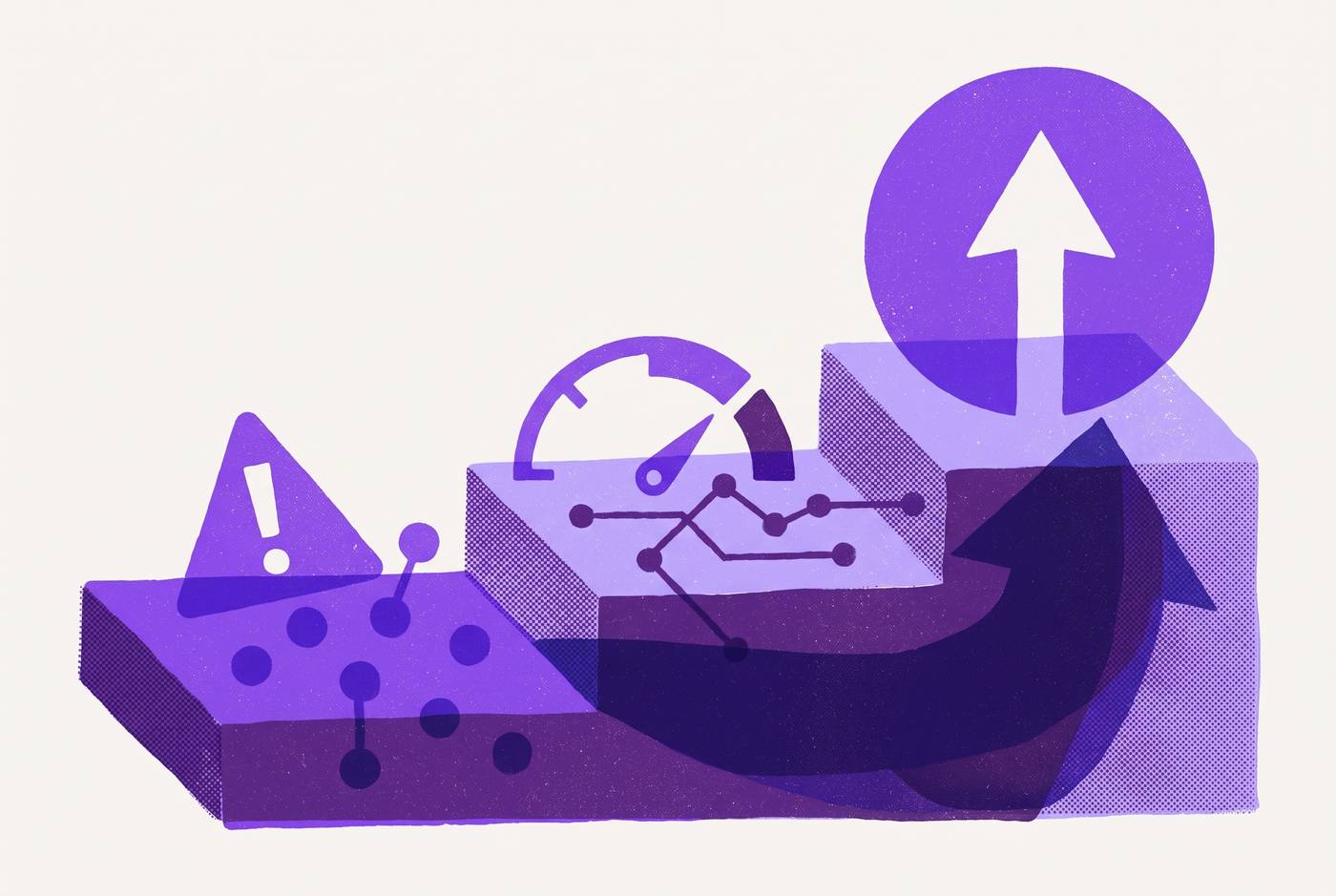
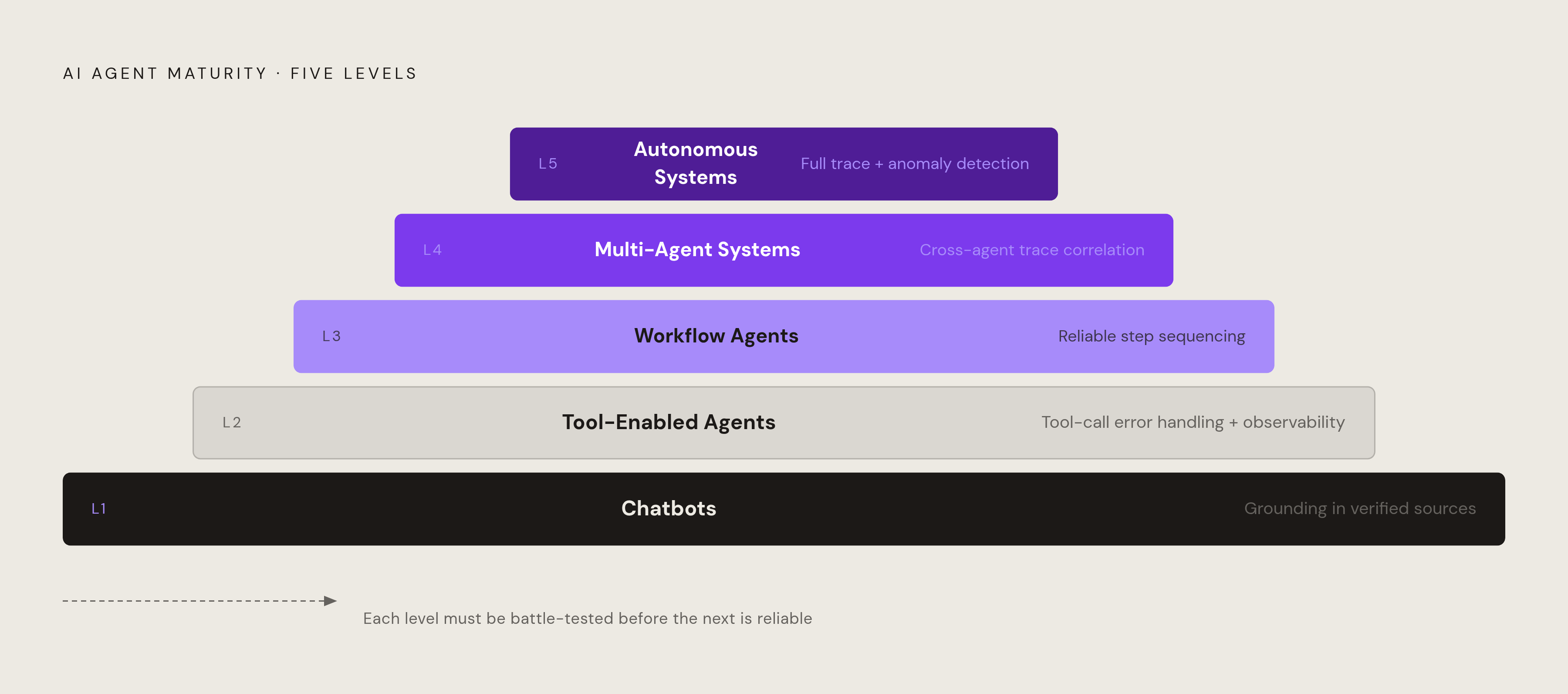
The map names five levels in one framework, which are Level 1 Chatbots, Level 2 Tool-Enabled Agents, Level 3 Workflow Agents, Level 4 Multi-Agent Systems, and Level 5 Autonomous Systems. Its pyramid structure makes the useful claim that each layer must be battle-tested before the next can be reliable.
Level 1 covers stateless question-and-answer without live system access or action capability, with grounding in verified sources as the central discipline. Level 2 adds tools that can cause downstream damage, so teams need tool-call error handling and early observability. At Level 3, a bad intermediate state can poison later steps in a sequence, so the main engineering challenge is to make the sequence reliable.
Level 4 adds delegation and hand-offs between agents, so a failure can propagate beyond the execution context where it began. The originating layer becomes harder to identify. Level 5 needs both autonomy and proof that the system has been reliable at every earlier level. Skipping a level brings its unresolved failure modes into a more complex system, where they are harder to tell apart.
Why the transition from workflow agents to multi-agent systems is where most programs break
A workflow failure can already be non-local across steps, but it remains within one agent's run. A developer can inspect that run manually and form a hypothesis. Multi-agent coordination removes that limited containment. One agent changes the state that another receives, and the causal chain crosses execution contexts. The transition demands a more capable model and exposes missing diagnostic infrastructure.
Three structural failure categories make this concrete. Tool schema drift occurs when remote APIs change while statically cached wrappers retain obsolete assumptions. Prompt ambiguity allows unconstrained instructions to produce parameter hallucination and state corruption across hand-offs. Workflow loops occur when execution has no exit condition, fallback, or format specification, so the agent repeats work or stops at the first error.
A malformed tool result or corrupted hand-off can condition downstream decisions, separating the visible symptom from its origin. Individual-agent inspection is no longer enough to follow that chain. Teams that established structured observability during Level 3 enter this transition with a basis for investigation. Those that postponed it must build the diagnostic machinery while already confronting cross-agent failures.
What observability actually needs to cover at each stage, and where infrastructure-level monitoring reaches its limit
Agent observability covers four distinct concerns, including monitoring, tracing, evaluation, and governance. Monitoring establishes whether execution occurred, at what cost, and with what latency. Tracing records the execution path, and evaluation checks whether the output met the quality criteria. Governance checks whether the agent stayed within the bounds of what it was allowed to do. A healthy runtime is only part of that picture.
Retrieval can supply an outdated policy before the model writes an answer. Infrastructure monitoring can show that retrieval completed, the response met its latency budget, and no exception occurred. The answer can still be wrong. Spans and token counts reveal what ran, but correctness requires evaluation of what the retrieved information and resulting answer meant.
At Level 1, infrastructure monitoring can support operations because failures remain output-level and can be assessed without trajectory analysis. Levels 2 and 3 need post-hoc evaluation against quality criteria as well as checks that the run finished. At Levels 4 and 5, teams need to see the whole trace and have real-time anomaly detection while the system runs. These monitoring tiers describe a different dimension from the five agent maturity stages.
To support that progression, each reasoning step should create a hierarchical span that can be replayed, with workflow and user IDs that help teams spot patterns across runs. Trace capture also needs a model of harness state, including prompts, memory, tool registries, and routing logic. Otherwise, the record exposes behavior without identifying the component that shaped it. Trace-to-dataset loops can then turn those records into material for evaluation of future changes.
Why root cause attribution is a trajectory-level problem, not a span-level one
Observability supplies the record, but attribution must explain it. A failed run or declining score triggers investigation without identifying whether the cause belongs to the prompt, tool, workflow, memory, model, or product logic. If step 2 produces a bad intermediate state that causes a symptom at step 7, inspecting step 7 alone identifies the symptom while missing what conditioned it.
Microsoft's AgentRx framework addresses this problem through constraint synthesis and LLM-based adjudication across agent trajectories. Its repository describes a ten-category root-cause taxonomy for grounded failure classification. AWS's Strands Evals SDK applies a related production-facing approach, detecting failures in execution traces and producing causal chains from root causes to downstream symptoms. Its recommendations specify the layer where a change belongs, such as the system prompt or tool description.
The useful output is a specific, layer-tagged diagnosis. A confidence score attached to “the run failed” does not tell an engineer what to change, and proximity within a trace does not establish causality. Attribution must account for how intermediate states shaped later decisions. Even then, diagnosis does not establish that the proposed repair will work. Correctly locating the cause and validating a recovery remain separate engineering tasks.
How harness rot accumulates across maturity stages and why it compounds
Anthropic's Claude Code team deleted roughly 80% of the system prompt when shipping Opus 5 because it contained corrections for behaviors the model no longer exhibited. The ablation produced no eval regression. Boris Cherny described the method as deleting the entire prompt, then bringing it back line by line to measure each line's impact. Repeating that process at model releases makes retaining prompt content conditional on testing.
This is the central mechanism of harness rot. The harness wraps the foundation model in the runtime structures that turn inference into task-directed execution, including input interfaces, memory, tool and skill registries, and workflow controllers. Teams add instructions to correct observed behavior, but later model releases can make those instructions redundant or harmful. The old repair becomes a new constraint.
Tool schema drift causes the same decay when the environment changes. A wrapper can be correct when written and become incorrect when a remote REST API changes its endpoints or parameter types. Without automated schema synchronization or runtime contract verification, statically cached wrappers can fail silently. Prompt maintenance alone cannot address that failure layer.
Rot compounds when an unrevised Level 3 harness enters Level 4 orchestration and interacts with other agents' prompts and tool schemas. Harness revision needs to be evidence-backed and systematic. A production failure provides a reason to investigate whether another instruction is the right repair.
Why shipping a fix without replay validation against production traces is shipping blind
Structured traces and layer-specific attribution make diagnosis possible, but neither establishes that a candidate change is safe. A repair can correct the original failure while breaking an execution path that was not involved. The diagnosis-to-recovery gap therefore demands a third discipline. After observing and attributing the failure, the team must validate the change against both affected production traces and traces whose behavior must not regress.
An evaluation harness runs that test by replaying proposed changes against past traces and scoring the outputs against quality criteria. Synthetic benchmarks cannot substitute for the actual distribution of production runs. Curated tests designed before a failure pattern emerged may not capture the conditions that produced it. Production replay connects the proposed repair to evidence from the system it will change.
The structured capture established upstream is what makes this possible downstream. Hierarchical spans preserve the execution path, while workflow and user tags help organize relevant traces into evaluation datasets. The Claude Code ablation provides the corresponding principle for prompt maintenance. Individual changes earn their place through measured impact rather than the apparent plausibility of an instruction.
Validation must also remain reviewable by the engineers responsible for deployment. They need to inspect what the proposed change does, why it is recommended, and which traces were used to evaluate it. An opaque auto-fix transfers risk to the team shipping a change whose evidence it cannot audit.
What each maturity stage demands operationally, mapped to the three disciplines
At Level 1, observation asks whether the answer is traceable to a verified source. Attribution is a source-level distinction between the right source and the wrong source, while validation consists of human review of sampled outputs. The investment is small, but it must exist. A chatbot without that grounding discipline has not established the foundation for reliable action.
At Level 2, observation extends to tool-call inputs, outputs, and error states. Attribution must distinguish tool-layer problems, including schema mismatch, latency, and malformed responses. Validation needs tests that run through the error-handling paths. Successful calls alone do not demonstrate readiness for the point where an agent begins affecting real systems.
At Level 3, observation requires the full execution path as hierarchical spans with replay capability. Attribution must reason across steps, while validation must include historical production traces alongside synthetic tests. The three disciplines become systematic at this stage. Reliable sequencing takes more than checking runs by hand and fixing problems one at a time.
At Level 4, observation must correlate traces across agent boundaries. Attribution must locate causes in a different agent from the one exposing the symptom, and validation must cover cross-agent interaction effects. The unit of investigation is now the coordinated execution. Strong diagnostics inside each agent do not establish that the team can explain failures between them.
At Level 5, all preceding disciplines remain prerequisites, with complete trace visibility and real-time anomaly detection supporting autonomous operation. Autonomy does not relax the requirement for attributable failures and validated changes. A practical diagnostic is whether the team can identify the responsible layer within a defined time window during a production incident. If it cannot, adding complexity will multiply incidents without improving the time needed to explain them.
How teams that treat harness engineering as a first-class discipline outpace those that treat it as cleanup
The performance gap follows from the change process. Advancing teams treat prompt revision, tool schema maintenance, eval design, and memory management with the rigor applied to code review and testing. Each change addresses a specific pattern of production failures, passes replay validation, and is reviewed by the team before it ships. Stalling teams treat the same work as a succession of isolated repairs, allowing unreviewed changes to become the source of later failures.
A disciplined process also gives old fixes an expiration test. When a model or tool changes, the team has evidence for deciding which harness elements remain useful and which now obstruct correct behavior. The next maturity stage becomes reachable through demonstrated control over the current one.