Prompt Versioning and Rollback in Production Agent Systems
One-word prompt changes can break production systems with no visible errors or alerts.
A one-word edit, changing "summarize the issue" to "summarize the issue concisely," tripled a support ticket backlog before anyone traced the regression back to the prompt change. No test failed. No exception fired anywhere in the stack. That gap, between a change that breaks nothing visibly and a change that breaks everything operationally, is the entire argument for treating prompts as versioned, gated, and reversible artifacts rather than as strings someone edits in a text box and ships.
The pattern repeats in a different shape. At 09:12 on 16 June 2026, a nightly ticket summarizer produced nothing, because it was calling a retired model. The API returned a 404. No alert covered it. Finding the cause took 41 minutes; fixing it took four. Anthropic's deprecation policy gives at least 60 days of notice before retiring a model, so the notice existed. It went to a shared inbox nobody reads. The policy worked fine. The operational path around it failed, and that's the gap where the incident actually lived.
None of this is a rounding error. A survey from Maxim AI found prompt engineering eats 30 to 40 percent of AI development time, and teams running multiple prompts in production consistently identify versioning as a leading operational headache. Prompts function as behavioral code, and code gets version control, promotion gates, and rollback paths for reasons that have nothing to do with fashion and everything to do with what happens when something breaks at 2 a.m. Prompts need the same discipline. Most teams give it to their code and skip it for their prompts, which is backwards: the prompt usually changes more often and gets reviewed less.
What needs versioning: the full agent harness, not just the prompt string
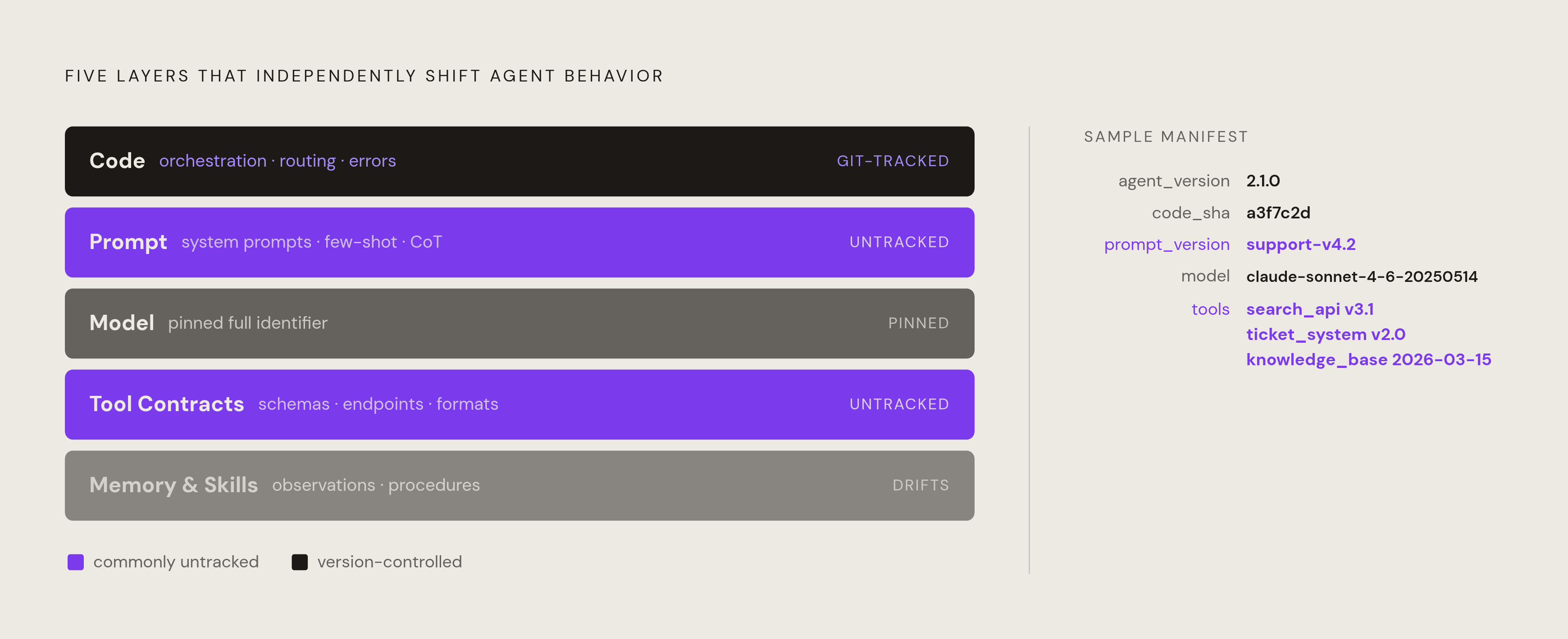
Treating "the prompt" as the unit of versioning misses most of what determines an agent's behavior. A single harness carries at least four layers, and each one can shift output on its own, independent of the others.
Code (orchestration logic, routing, error handling) is what everybody assumes covers the bases, and it's what most teams already track in Git. But it doesn't cover the bases. The prompt layer, meaning system prompts, few-shot examples, chain-of-thought scaffolding, typically lives somewhere else entirely, edited without the review process code gets. The model layer needs the full identifier pinned, not an alias: a specific model snapshot is not interchangeable with a later dated snapshot of the same model family, even when the marketing name stays identical. Tool contracts, the schemas, endpoints, and response formats of every tool the agent can call, count as a version change for the agent even when nobody touched a line of agent code. An upstream team ships an API update on its own schedule, and the agent's behavior shifts even though no one on the agent side has committed anything.
Recent thinking on agent architecture extends the list further, treating memory and skills as independently versioned components in their own right: memory stores prior observations and task outcomes, skills package reusable procedures into callable modules, and both drift on their own timelines.
A real deployment manifest ties the layers together into something reproducible. Production examples circulating in recent operational writeups show an entry that looks roughly like this:
- agent_version: "2.1.0"
- code_sha: "a3f7c2d"
- prompt_version: "support-v4.2"
- model: "claude-sonnet-4-6-20250514"
- tools: search_api v3.1, ticket_system v2.0, knowledge_base 2026-03-15
Whether any of this counts as real versioning is blunt: can the exact behavior be recreated from the manifest alone? If not, what's on file is a label rather than a version. Databricks made a related point in an August 2026 assessment: as base models get more capable, harness quality increasingly determines real-world performance, and in many live systems, upgrading the model alone produces smaller gains than expected if the surrounding infrastructure stays unstable. The model is rarely the bottleneck anymore. The scaffolding around it is, and teams that keep re-benchmarking the model while ignoring the harness are looking in the wrong place.
Multi-prompt chains compound the risk. When one prompt returns a JSON structure that a second prompt consumes downstream, a schema tweak in the first prompt silently breaks the second. Nothing throws an error. The pipeline just starts producing wrong answers that look plausible enough to pass a glance.
Hardcoded prompts breaking across environments as a system matures
Practitioners have identified four failure modes that appear repeatedly once a system has been in production long enough to accumulate scar tissue. Untracked changes let small edits alter behavior with no record of what changed or why. Coupled deploy cycles mean updating a single prompt requires a full application redeploy, which slows iteration and quietly discourages people from fixing things that need fixing. Environment drift lets dev, staging, and production prompts diverge with no clean path to promote or roll one back. And without isolated testing, a prompt can't be evaluated on its own; checking one change means running the entire agent stack end to end.
Agents make all four worse than they'd be in a typical service. Outputs are non-deterministic, so a test suite passing 98 percent of runs might be completely normal, or it might be the first sign of a regression, and there's no clean way to tell the difference without a baseline to compare against. Conversations carry state, and a user mid-conversation has no idea a new version just deployed; rolling back means someone has to decide what happens to session state the older version was never built to understand. And dependencies cascade: roll back Agent B to fix one problem, and Agent A might break, because Agent A depends on a response format only the newer version of Agent B ever produced.
Tool schema drift is the quietest of these failures, and arguably the most dangerous, because it rarely throws an error. It produces a malformed-but-plausible response that sails through downstream processing until a human eventually notices the output is wrong. n8n's postmortem from February 2026 is a clean illustration: upgrading from v2.4.7 to v2.6.3 caused the platform to start generating invalid tool schemas in its tool calls, breaking both OpenAI and Anthropic integrations at the same time. The tool argument schema had changed between versions, and nothing in the pipeline was set up to surface that change to the harnesses consuming it.
Description drift is a separate failure, and arguably worse, because a schema mismatch at least throws a runtime error you can catch. A description mismatch causes the model to call the right tool in the wrong situation, or the wrong tool altogether, with no error signal anywhere. Type checking won't catch it. Unit tests won't catch it. Static tests cannot catch a description mismatch because it appears only in the actual outputs; eval against real traffic is the only thing that catches it.
The foundational workflow: externalizing prompts as versioned artifacts
Every prompt should be treated as an immutable, versioned artifact. Once published, it doesn't get edited in place. Any change, however small, creates a new version instead of mutating the old one, and teams that skip this step are the same ones who end up debugging a regression by asking around to find out who touched the prompt last.
Semantic versioning gives that discipline a shared vocabulary. A major version bump signals a behavioral or output-contract change, the kind that could break something downstream. A minor bump signals a capability improvement that shouldn't change the contract. A patch is a small fix, nothing structural. Every version, regardless of size, carries metadata: who wrote it, when, why, and what the evaluation results looked like before it shipped.
DevOpsBoys laid out a practical pattern for this in a 2026 writeup: store each prompt as a YAML file, something like prompts/incident_summary/v3.yaml, holding name, version, created_at, author, changelog, template, model, max_tokens, and temperature. Prompt changes then become ordinary Git commits to YAML files, reviewable in pull requests with diffs that show, line by line, what changed in the wording. A reviewer sees "concisely" get added to a sentence the same way they'd see a variable rename, which is precisely the point: the same one-word edit that tripled a ticket backlog would have shown up in a diff instead of vanishing into a live prompt nobody double-checked.
A PromptRegistry class loads prompts by name and version at runtime, caches what it loads, and resolves "latest" by sorting the versioned files it finds. That separation, between what a prompt is and which pointer currently deploys it, is the mechanism that makes rollback fast later on. Skipping this and just always loading the newest file is tempting, and it's a mistake. "Always use the newest prompt" turns every edit into an instant production change with no review gate standing between someone's keyboard and live traffic. Pinning an explicit version in a config file turns promoting a new version into a deliberate, reviewable action instead, which is the entire point.
Prompts often need input from people who aren't engineers: product managers and domain experts who understand the support queue or the sales script better than anyone on the platform team does. Agenta's guide, published 2026-02-11, makes the case that a versioning system has to support their workflow directly, rather than routing every wording tweak through an IDE and a build pipeline. Pure Git-based approaches tend to break down exactly at this point, once a team grows past the engineers who are comfortable with pull requests.
Gating promotion through evaluation against real traces
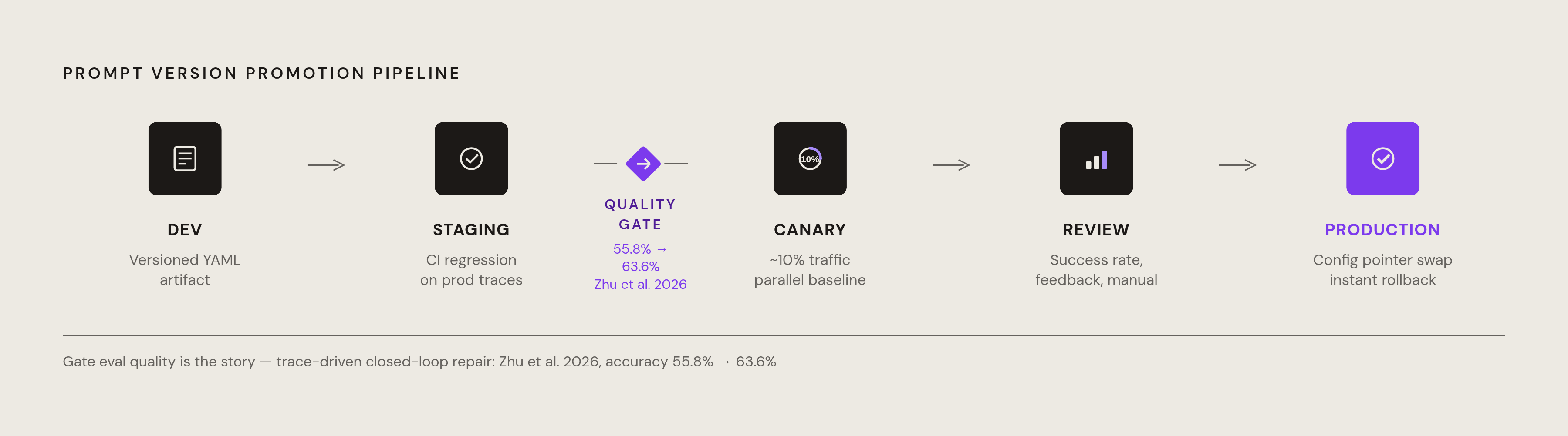
Versioning by itself is just record-keeping. It tells you what changed and when, but nothing about whether the change was any good, and treating it as sufficient on its own is the mistake that lets bad prompts reach production with a clean audit trail behind them. Braintrust's prompt versioning guide, published 2026-02-18, frames the shift from passive to active well: the discipline only starts doing real work once a version has to pass an eval before it's allowed to promote.
Eval-before-promotion treats a prompt version the way a codebase treats a pull request. It doesn't reach production just because someone wrote it and felt good about it. A three-environment model, dev to staging to production, gives that gate somewhere to live: new prompt versions land in staging first, get validated against evaluations there, and only get promoted once someone's confident the numbers hold up. Staging exists specifically to keep a bad prompt from reaching customers before anyone notices.
Automated regression tests catch some of this and miss the rest. DevOpsBoys reports that they're reliable for catching prompts that lose required structure, drop context they were supposed to carry forward, or start hedging in ways that break whatever's parsing the output downstream. What they can't catch is every semantic regression, because LLM outputs are non-deterministic by nature. Even a test suite passing at a high rate leaves a residual failure rate on the table, and that residual might be entirely normal or might be the early signal of a real problem; nobody can say from the pass rate alone. A common test shape that works in practice: a set of labeled inputs with structural assertions, run in CI before any version becomes eligible for a canary rollout.
The strongest eval signal doesn't come from a synthetic benchmark someone wrote in advance. It comes from production traces, because traces capture the actual distribution of inputs the agent hits in the wild, including the edge cases no one thought to write a test for. Research from Zhu et al. on arXiv in 2026 backs this up from a different angle: on the GAIA benchmark, a closed-loop repair approach, one that traces a failure back to its root cause and fixes it there, corrected 13 of 73 failed tasks in a single rerun, compared with 4 to 6 for decoupled self-correction baselines that don't trace attribution the same way. Overall task accuracy moved from 55.8 percent to 63.6 percent. Eval gates connected to trace-driven repair beat a simple pass-or-fail score sitting in isolation, and the gap isn't small.
Canary rollout is the last check before full promotion. Route the new prompt version to something like 10 percent of traffic, keep the stable version running as the baseline for comparison, and use deterministic bucketing so any given user consistently lands on the same version for the duration of the test rather than flipping back and forth mid-conversation. Promotion to full traffic happens only once quality metrics, user feedback, task success rate, and manual review scores together confirm nothing regressed.
Rollback as a pointer swap, not a redeploy
Which prompt version is active should be a runtime config read, not something baked into a compiled artifact. That single decision is what makes rollback instant instead of a project, and it's the design choice most systems get wrong from the start by baking the version into the deployment itself.
If the active version lives in a feature flag system or a config service rather than in a deployed file, a rollback takes effect the moment the config changes, with no application deployment involved. DevOpsBoys lays out the mechanics: read the active version config, record the current version as the previous one for the audit trail, write the target rollback version, and log the event along with a reason. If the config lives in a service, the change is live immediately. If it lives in a deployed file, the change needs only a config push, not a full redeploy.
Blue-green deployment for agents needs one adjustment that traditional services don't: session awareness. Two environments run side by side, but the traffic switch can't just happen instantly, because existing conversations need to either drain out or hold on the old environment until they finish. New conversations route to the new environment right away. Rollback, at that point, is a load balancer flip.
Rolling back mid-conversation forces a decision about what happens to state the older version was never designed to read. Draining, waiting for active sessions to finish naturally before cutting over, is the lowest-risk option when conversations run short, and it should be the default. State migration, trying to translate the newer version's state format back into something the old version understands, is usually the nuclear option: it tends to cost more time and introduce more risk than the problem it's solving, and teams reach for it far more often than the payoff justifies.
Smoke tests for agents need to check behavior, not uptime. A /health endpoint returning 200 proves the process is running; it proves nothing about whether the agent is doing its job. The check that actually means something sends representative queries and verifies the responses land within expected bounds, not exact matches, since outputs are non-deterministic by nature, but bounds a human would recognize as sane.
Compare all of this to a system without externalized, pinned prompts. Rollback there means someone trying to remember the old wording from memory, getting some detail wrong, and redeploying the entire service to test whether they got it right. The 41-minute detection window in the model-deprecation incident wasn't only a monitoring gap. Part of that delay was the simple absence of a rollback path anyone could reach for once the cause was found.
Observability: what you need to see before you can detect a regression worth rolling back
None of the machinery above matters if nobody notices a regression happened, and by most current signals, a lot of regressions go unnoticed. Gravitee's State of AI Agent Security report found 88 percent of organizations running AI agents reported some kind of incident, yet confirmed incident rates actually dropped between December 2025 and April 2026, even as agent fleets roughly doubled over the same window. Researchers reading that gap point to underreporting and detection failure, not improved reliability. Agents are failing more than teams can see, which is a worse problem than agents simply failing more, because at least a visible failure gets fixed.
Standard application performance monitoring wasn't built to catch most of what actually goes wrong here. Agent incidents tend to stem from tool-call failures, context getting truncated, or runaway loops, none of which resemble the errors APM tools were designed to flag, and none of which become visible without instrumentation built specifically for agent behavior.
Three layers of telemetry cover the gap. Traces capture the end-to-end flow, from user input through every tool call and model invocation to the final output, structured as a tree of spans that shows how one step led to the next. Logs capture the discrete events inside that flow: which tool got called, with what parameters, what came back, and what errored along the way. Performance metrics round it out: latency per span, total tokens consumed on both the input and output side, cost per request, error rates, and the model identifiers actually used for each call.
OpenTelemetry's GenAI semantic conventions are turning into the closest thing to a portable standard here. The spec defines four span operation types built specifically for agents: create_agent, invoke_agent, invoke_workflow, and execute_tool. Datadog began supporting these conventions natively from v1.37 onward, announced December 1, 2025, mapping gen_ai.* attributes automatically into its own LLM observability schema, which saves teams from having to hand-build that translation layer themselves.
Context degrades in ways that should get tracked as its own metric, not folded into some general "quality" number nobody checks. Research from MemU quantifies the loss at roughly 2 percent per step in a multi-step workflow, which sounds small until it compounds: by five cycles, less than 60 percent of the original context remains reliably accessible to the model. That number deserves the same per-run attention teams already give latency or cost, and most teams don't give it any.
Tool calls fail on their own even in systems that are otherwise well-built, somewhere in the range of 3 to 15 percent of the time according to recent operational research. Telling a tool-call failure apart from a full run failure is a prerequisite for figuring out what actually broke. Conflate the two, and root cause analysis turns into guesswork dressed up as an investigation.
A short checklist separates teams that can actually catch a regression from teams that only think they can. Can any run be replayed in full from its trace? Do steps-per-run and cost-per-run trigger an alert when they drift? Can a tool-call failure be told apart from a run failure at a glance? Can a failed run be reconstructed from structured logs alone, without guessing? And is task success measured with an actual evaluation, rather than inferred from the absence of complaints?
None of the rollback machinery, the pointer swaps, the canary gates, the immutable version files, does any good without this layer, which produces the signal that triggers their use, as the following point confirms. A rollback path is only as useful as the observability that tells someone it's time to use it.