Selecting an Agent Harness Framework for Production Deployment
The harness architecture matters more than model choice for production reliability and performance.
Selecting an Agent Harness Framework for Production Deployment.
The harness layer now decides production reliability more than the model does
Picking a harness framework for a production agent is not a matter of comparing feature checklists. It's a decision about which architectural properties hold up once the agent meets real traffic, real failures, and real cost pressure, and those properties (execution control, observability, tool governance, memory) rarely show themselves until well after launch. Gartner expects 40% of enterprise applications to ship with task-specific AI agents by the end of 2026, and at that scale, a framework choice stops being something you revisit next quarter. Once dozens of workflows depend on a given execution model, ripping it out costs real engineering time, so the decision needs to be right early, not eventually.
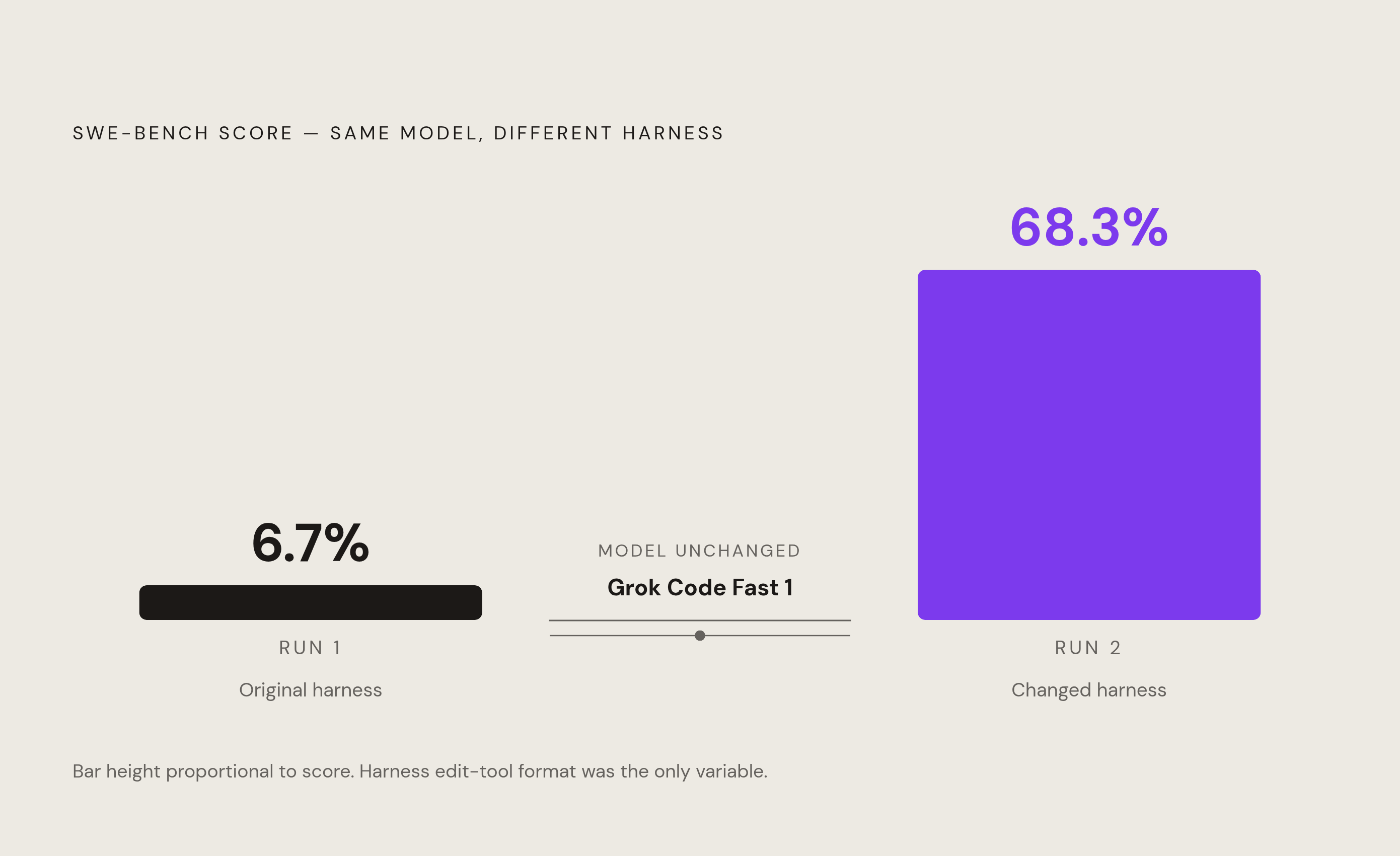
Most teams treat the harness as plumbing and the model as the product. That gets the emphasis backward. A widely cited 2026 Hacker News thread, later folded into the Awesome-Agent-Harness survey's account of practitioner consensus, argued that the AI should be treated as the entire cybernetic loop connecting the model to its harness, since the harness moves outcomes as much as any upgrade to the model itself. That claim has a number behind it. When researchers changed only the edit-tool format in the harness wrapped around Grok Code Fast 1, leaving the model itself untouched, its SWE-bench score jumped from 6.7% to 68.3%. The model was constant in both runs. The harness was the only variable that moved, and it moved the outcome by a factor of ten. 2026 (Claw-SWE-Bench) show up to ~3.8× performance difference on SWE-bench-style tasks from harness adapter variation alone (19.1% vs 73.4% Pass@1 on the same model backbone).
The six components a production harness must implement
The 2026 Awesome-Agent-Harness survey, which reviewed more than 110 papers and 23 deployed systems including production stacks at Stripe, OpenAI, Cursor, and METR, formalizes the harness as a six-part structure: H = (E, T, C, S, L, V). Each letter maps to a job the harness has to do, and each has its own way of breaking when it's left out.
E is the execution loop: observe, think, act, plus the termination conditions and error recovery that keep the loop from running forever. T is the tool registry, a typed catalog with routing, monitoring, and schema validation attached. C is the context manager, which governs what actually enters the context window, how it gets compacted, and how retrieval happens; done well, it shows the model only the minimum telemetry a sub-task needs, so the model doesn't drown in irrelevant state. S is the state store, responsible for persistence across turns and sessions and for recovering after a crash. L covers lifecycle hooks: auth, logging, policy enforcement, instrumentation. Drop this component, and safety policy no longer has a system enforcing it; you are left hoping it holds. V is the evaluation interface, capturing action trajectories, intermediate states, and success signals; without it, failures appear only as bad outputs, with no way to trace which layer actually caused them.
Research prototypes often cover only 2–3 components. That gap is exactly where a demo agent and a production agent part ways. Drop L, and policy becomes aspirational instead of enforced. Dropping V turns every failure into a mystery you can watch happen but never localize. Dropping S means the agent can't come back from a crash or an idle period at all, which is precisely the gap Google's May 2026 guide to production agents was written to close, with DatabaseSessionService for persistent sessions, webhook-triggered resumption, and explicit state machines that let containers scale to zero without losing context.
Execution control, state persistence, and workflow termination under production load
Every execution path an agent can take needs a hard ceiling, such as a step limit, a token budget, or a wall-clock timeout. If that ceiling is left undefined, one ambiguous task will happily consume unbounded compute. This is the default way agents fail in production, not the exception. The agent calls the same tool over and over with the same arguments, or it gets stuck cycling between two sub-goals that each depend on the other finishing first.
State persistence has its own version of the same problem, visible over longer stretches of time instead of within a single run. Agents that pause and resume, or that sit idle between triggers, need durable session state instead of a blob of raw JSON sitting in a vector database and hoped to still make sense later. Google's May 2026 guidance addresses this directly, pairing explicit state machines with webhook-triggered state_delta resumption so a container can scale down to zero and come back without dropping context. Meta's Ranking Engineer Agent, built for ads-ranking research workflows, runs on a hibernate-and-wake mechanism that lets it pick back up on multi-day tasks after being paused, the same pattern proven out at a different scale.
Both of these trace back to an older architecture question: one large agent, or several small ones. Take a position on it, because the evidence points one way. A monolithic agent is fast to build and demo, but it's brittle once load arrives, and when it fails, it fails completely, since there's no boundary to contain the damage. The better pattern borrows from microservices: each sub-agent owns exactly one responsibility, and a supervisor layer routes between them, so a broken piece gets swapped out without touching the rest of the system. Google's own Agent Bake-Off work backs this up directly. Team Daniel and Luis cut processing time from an hour to ten minutes just by running narrowly scoped agents in parallel instead of one broad agent working sequentially. When you evaluate a framework, check whether termination conditions are enforced structurally by the execution model itself or merely depend on the prompt politely asking the agent to stop. Only one of those actually holds under load.
Tool governance: schema validation, drift detection, and routing deterministic logic away from the LLM
Tool calling is a probabilistic text-generation task dressed up as a JSON structure. When tokens come out slightly malformed, or the schema no longer matches, or the provider times out, the agent fails. Sometimes it fails loudly. Often it fails silently, or worse, it hallucinates a plausible-looking result and keeps going as if nothing happened. In production, tool calls fail somewhere between 3% and 15% of the time depending on model size and task complexity, and some full agent workflows fail as often as 41% of the time.
Much of this traces back to schema drift. Tool schemas evolve, but the LLM's prompt describing that tool doesn't always keep up. Incompatibilities creep in from API changes, from drifting schemas, or simply from inconsistent abstraction layers sitting between the agent framework and whichever LLM provider sits behind it. Retrying blindly doesn't fix any of this: feeding the same malformed-JSON error back into the same prompt just reproduces the same error. Self-correction requires the harness to hand the model explicit, structured feedback about what went wrong.
The design principle that follows is simple, even though most teams ignore it in practice. Reserve the LLM's reasoning for genuine ambiguity and intent resolution. Anything with one deterministically correct answer, arithmetic, a status lookup, a rule-based branch, belongs in ordinary code, not in a prompt. That split is what keeps inference costs predictable and keeps error rates somewhere you can actually manage.
Memory, context management, and the skill-library problem that complicates both
Two different jobs get lumped together under the word "memory," and they are not the same job. One is durable facts and experience: things that need to survive across sessions, crashes, and idle stretches. The other is reusable procedure: executable workflows that turn a fresh task from "invent a plan from scratch" into "pick the right playbook and follow it". Conflating the two is where the trouble starts.
A 2026 arXiv paper, "Memory-Skill Isomorphism: One Skill Carrier, Two Native Uses," names the operational cost of treating memory and skills as separate subsystems: separate stores, separate routing logic, separate context injection, separate update APIs, separate validators. Building all of that twice leaves you with an execution loop that works fine on its own terms sitting on top of a control plane that's twice as hard to run.
Context management brings its own failure mode, often called context rot. The longer a session runs, the more the older material in the window degrades the model's reasoning, and a 40-minute agent run stays coherent almost entirely on the strength of the compaction strategy behind it. The main defense is progressive disclosure: show the agent only the minimum context its current sub-task actually needs, not everything it might conceivably want. LangChain's structural breakdown of harness design places context management alongside filesystem access, code execution, sandboxing, and memory as one of five core primitives a harness has to get right.
Observability and evaluation inside the workflow, not after the fact
LLM observability and agent observability get talked about as if they're the same discipline. They are not the same discipline. LLM observability watches the prompt, the response, token counts, cost, and latency. Agent observability has to explain the workflow in between, the span tree. Security and risk concerns are cited by nearly two-thirds of respondents, and knowledge and training gaps by nearly 60%, as among the top barriers to scaling agentic AI.
That blindness carries a real cost. Agents graded only on final-output quality pass 20% to 40% more test cases than a full trajectory evaluation would allow, and four of the five major failure modes, loops, tool errors, plan divergence, and cost runaways, all happen upstream of the final response, invisible to any evaluation that checks only the last message. Grading the destination and skipping the route means missing most of what actually went wrong.
What the four leading frameworks provide against these criteria
LangGraph, CrewAI, AutoGen (now folded into the Microsoft Agent Framework), and Mastra are the most-searched and most actively maintained options in this space.
LangGraph is at 41,900 GitHub stars as of September 18, 2026, and ships under an MIT license at its core, though the production server uses the Elastic License 2.0 and the LangSmith layer carries a paid tier. Its explicit state graph, with built-in checkpointing, streaming, and human-in-the-loop primitives, gives it the strongest native coverage of the E, S, and L components of the four. Klarna's support agent, built on LangGraph-adjacent infrastructure, now handles two-thirds of customer service inquiries, work equivalent to roughly 853 full-time employees, saving an estimated $60 million a year. Teams commonly prototype on a lighter framework and migrate to LangGraph once their workflow's state complexity outgrows what the lighter tool can hold, and that migration pattern says something real about which architecture survives complexity. The tradeoff is a steeper learning curve, and teams should expect to pay it.
CrewAI takes the opposite bet: fastest path from idea to a working multi-agent prototype, through a role-decomposed architecture. Since version 1.10.1, it has added streaming support, compatibility with the Agent-to-Agent protocol, and MCP integration. CrewAI reports 2 billion agent executions over the trailing 12 months and more than 150 enterprise customers as of 2026, numbers that reflect genuine adoption. But the pattern repeats often enough to be a warning: teams start on CrewAI and later move to LangGraph once state complexity outgrows what CrewAI's model comfortably handles, so weigh that migration cost before committing if the workflow is likely to become stateful later. CrewAI also has no native data quality layer, so schema drift and context governance both have to be bolted on from outside. That's a real gap, not a minor one, for anything touching production tool calls.
AutoGen has moved into maintenance mode, receiving bug fixes and critical security patches from the community but no new features, and Microsoft's own README now directs new users toward the Microsoft Agent Framework instead. That framework reached general availability in April 2026, arriving as a production-grade agent runtime with a CodeAct mode that lets agents write and execute Python directly instead of emitting JSON tool calls, sidestepping a good chunk of the schema drift described earlier. Its companion Microsoft Agent Governance Toolkit enforces governance decisions deterministically before actions reach the wire, so a blocked action is structurally impossible rather than merely unlikely, making it the strongest L-component implementation in the comparison. The fit is narrower, though: it's built for.NET shops and organizations already committed to Microsoft's stack, with native Azure RBAC integration, and teams outside that ecosystem take on real extra integration cost to use it.
None of these four frameworks wins outright across all six components. Each trades strength in one area for a gap somewhere else, and that tradeoff, more than any star count or benchmark score, is what should decide which one fits a given production workload. If a workflow is going to grow stateful and long-running, start with LangGraph and absorb the learning curve early, rather than paying for a CrewAI migration later. If the workflow is genuinely simple and short-lived, the calculus reverses. Multi-agent systems in general still fail at rates between 41% and 86.7% in production according to the MAST taxonomy, validated across more than 1,600 execution traces at NeurIPS 2025, which is the number that should anchor expectations more than any individual framework's marketing page https://atlan.com/know/best-ai-agent-harness-tools-2026/. Gartner projects that 40% of enterprise applications will include task-specific AI agents by end of 2026 https://atlan.com/know/best-ai-agent-harness-tools-2026/. A 2026 survey reviewed 110+ papers and 23 systems including production deployments at Stripe, OpenAI, Cursor, and METR https://github.com/Gloriaameng/Awesome-Agent-Harness. Klarna's support agent workload is equivalent to roughly 853 full-time employees https://atlan.com/know/best-ai-agent-harness-tools-2026/. Klarna's LangGraph-adjacent support agent saves an estimated $60 million per year https://atlan.com/know/best-ai-agent-harness-tools-2026/. CrewAI reports 2 billion agent executions in the trailing 12 months as of 2026 https://atlan.com/know/best-ai-agent-harness-tools-2026/. CrewAI has 150+ enterprise customers as of 2026 https://atlan.com/know/best-ai-agent-harness-tools-2026/. Tool calling fails 3 to 15% of the time in production depending on model size and task complexity https://atlan.com/know/best-ai-agent-harness-tools-2026/. Some agent workflows fail closer to 41% of the time in production https://atlan.com/know/best-ai-agent-harness-tools-2026/. Agents evaluated only on final-output quality pass 20–40% more test cases than full trajectory evaluation reveals https://atlan.com/know/best-ai-agent-harness-tools-2026/. AutoGen / AG2 has 61,042 GitHub stars, the highest in the 2026 comparison list https://atlan.com/know/best-ai-agent-harness-tools-2026/. CrewAI has 58,729 GitHub stars, the highest among role-based orchestration frameworks https://atlan.com/know/best-ai-agent-harness-tools-2026/. LangGraph has 41,900 GitHub stars as of September 18, 2026 https://atlan.com/know/best-ai-agent-harness-tools-2026/. Mastra has 19,000+ GitHub stars https://atlan.com/know/best-ai-agent-harness-tools-2026/. Pi Research's Grok Code Fast 1 jumped from 6.7% to 68.3% on SWE-bench by changing only the harness edit-tool format with the model unchanged https://github.com/Gloriaameng/Awesome-Agent-Harness. Google's Agent-to-Agent (A2A) protocol has 50–200ms latency https://github.com/Gloriaameng/Awesome-Agent-Harness. TrueFoundry achieves approximately 10 milliseconds latency even under load https://www.truefoundry.com/blog/best-agent-harness-in-2026.
Sources
- Top AI Agent Harness Tools and Frameworks 2026: Complete Guide
- GitHub - Gloriaameng/Awesome-Agent-Harness: Agent Harness for Large Language Model Agents: A Survey. Survey on LLM agentharnessengineering with a taxonomy. 110+papers, 23 systems analyzed.
- Best Agent Harness in 2026: Top 5 Options Compared