Layered Architecture of an AI Agent Production Stack
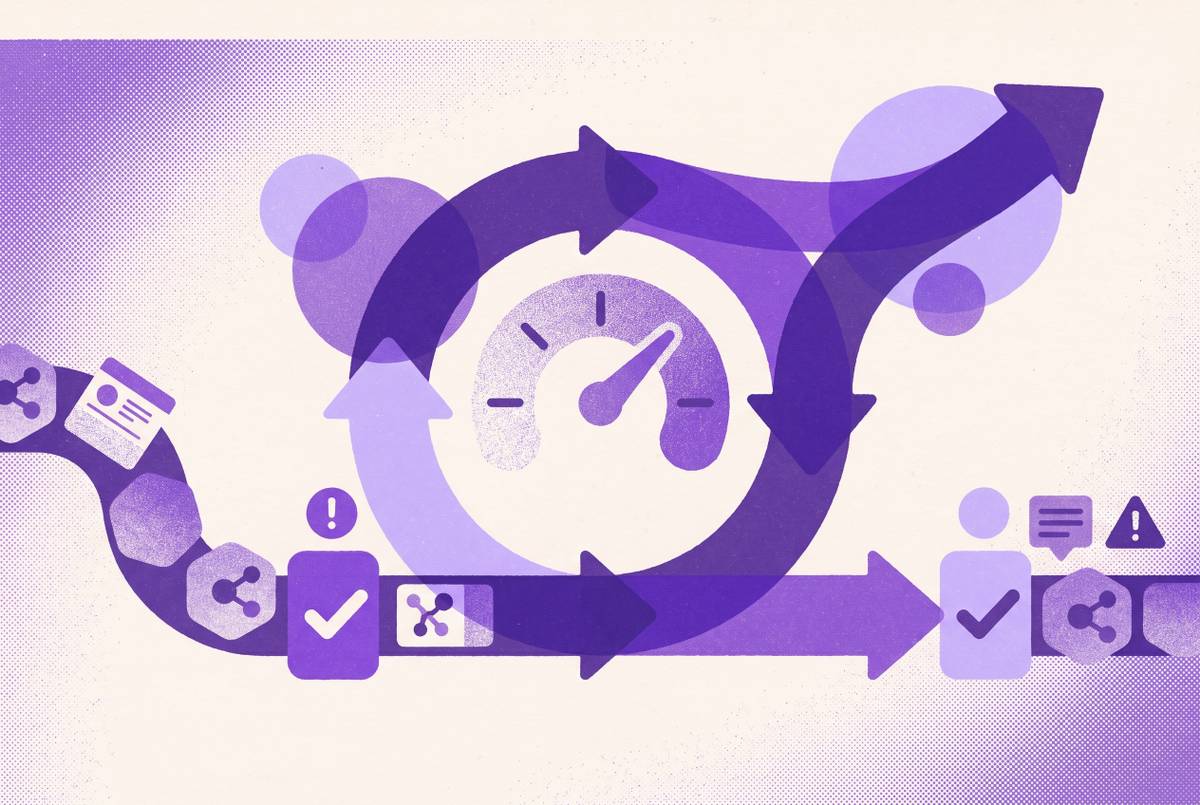
Context corruption at the foundation travels silently through every layer above it.
The standard six-layer stack diagram tells an engineer what each part of an agent system does. It says nothing about where to look when a production run goes wrong, which is the only question that matters at 2am with a broken trace open in one window and the architecture diagram open in another, uselessly, in the next.
The standard layer-by-layer stack diagram misleads engineers troubleshooting live agents
An engineer staring at a failed agent run has a trace full of tool calls, retrieved documents, memory reads, and a final wrong answer. Pinned to the wall, or more likely open in another tab, is the stack diagram: six clean boxes stacked vertically, each labeled with its function. The diagram answers "what does this layer do?" six times over and answers "which layer broke this run?" zero times. That mismatch is the actual obstacle, not a lack of documentation about what retrieval or memory or orchestration are supposed to do in principle.
The shape of a production agent system in 2026 looks less like a clean vertical stack and more like an operating system: layers with lateral dependencies, two rails running across every layer rather than beside them, and failure modes that cross boundaries instead of staying put inside the layer where they started. A diagram built to describe function, rather than failure, is the wrong tool for the job an engineer actually needs done during an incident. But they cluster reliably enough that misattributing a failure, blaming the model when the harness is broken, or blaming retrieval when the underlying data was stale to begin with, has become the single largest source of wasted debugging effort in live systems. What engineers need is not a better function diagram but a map organized by symptom: given what the trace shows, which layer most likely owns it, and what does a real fix at that layer look like.
How the production agent stack is organized
A production agent stack is best understood as six horizontal layers wrapped by two vertical rails that touch every one of them. Ordered from where a human meets the system down to where the system reaches out and takes action in the world, the six layers run: Agent Interface / Harness surface, Agent Runtime / Orchestration, Memory, Knowledge / Retrieval, Tooling, and Model / Reasoning. The two rails, Observability and Evals on one side, Governance and Security on the other, cut across all six rather than sitting above or below them, and a large share of the silent failures that reach production go undetected precisely because nobody is watching the rails as closely as they watch the layers.
The harness deserves particular attention because it is routinely misunderstood. The harness is the complete software infrastructure wrapping the model: the orchestration loop, the tool interfaces, the memory system, context management, state persistence, error handling, and the guardrails that sit around all of it. The model itself is one component living inside that wrapper, not the center the rest of the system orbits. Each layer passes its output to the one above it, and when a layer produces a corrupted output, stale context, a misread tool response, a prompt that drifted from its original intent, that corruption travels silently through every layer above it until something finally produces a visibly wrong action, or produces no action.
Production teams consistently misplace their attention across the stack, and the rest of this piece works up that stack, one failure class at a time, starting at the bottom.
Context substrate failures: why stale or incoherent data at the foundation corrupts every layer above it
Context substrate failures are the most dangerous class in the entire stack. They throw no exceptions, they propagate through every layer built on top of them, and they get misattributed to the reasoning layer more often than any other failure type.
The context substrate is the foundational knowledge layer underneath retrieval and memory: structured data, unstructured documents, real-time signals, unified under one set of access patterns. When that consistency breaks, an agent can end up acting on a view of the world that is internally coherent and simply wrong, because two or three different sources were queried at slightly different moments and returned snapshots that don't agree with each other.
The failure is silent because there is no HTTP error, no exception, no timeout to catch. The agent reasons correctly over inputs that are themselves wrong and produces an answer delivered with full confidence. The resulting wrong action gets read as a reasoning error nearly every time: an engineer adjusts the prompt, or swaps out the model for a newer one, and the failure returns on the next run because nobody touched the stale or incoherent context that actually caused it. Agents don't tolerate latency or stale state the way a human reviewer glancing at a dashboard might; every iteration of an agent's loop builds on the iteration before it, so a small inconsistency introduced at the first turn can grow into a serious divergence by the fifth. Once the substrate underneath an agent is fresh and internally consistent, the next place a well-built system can still go wrong is one layer up, in retrieval itself.
Retrieval layer failures: when the agent gets the right data source but the wrong slice of it
Retrieval failures are a distinct problem from context substrate failures. The data is fresh, it is correct, it sits in the store exactly as it should, but the search layer returns the wrong slice of it: chunks that look relevant on the surface and are not the ones the agent actually needed.
Most production systems now combine vector search with keyword search, because vector search alone tends to fail on exact-match lookups like version numbers, identifiers, and proper nouns, while keyword search alone misses the semantic intent of a question phrased differently than the source document. The resulting failure signature looks clean: the agent gives an answer that is internally consistent with what it retrieved, and the retrieved chunks turn out to be from the wrong document version, the wrong customer's record, or an embedding that was cached before the underlying document changed. Catching the error requires comparing the retrieved content against a known correct answer, which is evaluation infrastructure most teams haven't built at the retrieval layer specifically.
The memory layer makes this worse when the two interact badly. Attribution discipline matters here: a retrieval failure belongs to the retrieval layer, not the model. Swapping the model will not fix an index built on outdated documents, and it will not fix a hybrid search tuned for the wrong balance between recall and precision.
Memory failures: how stale or unvalidated persistent state becomes an active liability
Memory failures are not the same thing as retrieval failures, even though practitioners frequently lump them together. A memory system can return a result with perfect provenance, correctly stored and correctly retrieved, that is simply no longer true, and an agent that acts on it will do so with complete confidence that it is right.
Memory exists to let an agent carry state across time so continuity doesn't depend on whatever happens to be in the current context window. Anything persisted to memory is a snapshot of the world at the moment it was written, and the world keeps changing after that moment passes, which is exactly where memory breaks. The characteristic failure looks like this: an agent skips a tool call or a fresh retrieval because it already "knows" the answer from memory, except that answer was correct for a prior session, a prior branch of a conversation, or a prior state the user has since moved past. That skip is invisible in a standard trace unless memory reads are logged as first-class events with their own timestamps.
GitHub has deployed repository-scoped memory storage shared across Copilot CLI, Copilot coding agent, and Copilot code review, and built a just-in-time verification step that checks citations against the current branch before the system relies on them, precisely because a memory entry written against one branch state can go stale the moment the branch moves. In multi-agent systems the same problem takes on a cross-agent dimension: one agent writes a memory entry, a second agent reads and acts on it, the first agent's underlying assumption turns out to be wrong, and the failure becomes visible in the second agent's action. Memory quality, in practice, is a freshness and invalidation engineering problem. Teams that timestamp memory writes and attach validity conditions to them catch this class of failure. Teams that treat memory as a plain key-value store miss this check, and the next failure is usually a wrong tool call built on a memory entry nobody checked.
Tool layer failures: schema drift, silent HTTP 200s, and the retry storms that exhaust budgets
The tool layer is where an abstract reasoning error turns into a concrete, sometimes irreversible, action in an external system, and it carries the highest blast radius of anywhere in the stack. The most damaging failure here is also the hardest to catch in a standard trace: a tool call that returns an HTTP 200 success code alongside a corrupted or empty payload.
That silent-success pattern is the most damaging of the tool-layer failures precisely because it defeats the normal instinct of checking for errors; there isn't one to check for.
Two related failure types round out this layer, each with its own cause and its own fix. Retry storms happen when an agent hits an HTTP 429 rate limit and has no bounded retry logic to stop it: each retry burns tokens and time, and the cascade keeps going until the budget runs out, looking in the trace like a timeout or a cost overrun rather than what it actually was, a rate limit nobody handled. Standard tracing tools are built to show what the agent decided to call and why. They were never built to manage network state, authentication lifecycles, or the third-party API schemas that drift out from under a tool interface without warning, and blaming the reasoning layer for any of these three failures is the single most common misattribution made at this level of the stack. A schema drift failure belongs to the tool layer, not the model: the model reasoned correctly, but the interface it was calling changed shape underneath it, so the fix belongs in the connector.
Orchestration and workflow failures: loops, premature termination, and state that diverges across agents
Orchestration sits one layer above tools, and its failures look nothing like a tool failure or a model failure. Here, every individual component can work exactly as designed, the model reasons well, the tools return correct results, and the run still fails, because the logic sequencing those components together either never stops or stops too soon.
Agents without clearly defined exit conditions tend to swing between two failure states. One is an infinite retry loop that keeps consuming tokens until the budget runs dry. The other is paralysis, where the agent simply stops without producing an output and without any signal explaining why. Neither failure originates in the model; both originate in missing exit conditions inside the orchestration logic. A subtler version of the same problem occurs in long-running autonomous workflows, ten turns or more, where intermediate tool outputs pile up inside the conversation history. If the agent re-selects which tools to use on every turn based on the latest state of that accumulating scratchpad, small shifts in context can nudge tool selection just enough, turn after turn, that the whole run settles into a cycle that never converges on an answer.
Multi-agent architectures introduce a failure of their own: state divergence. Catching that kind of divergence requires tracing that correlates state across agents, not just within one agent's own run. Runtime governance belongs squarely at this layer rather than at the model layer: the approach taken by the Microsoft Agent Governance Toolkit, enforcing governance decisions deterministically before an action reaches the wire so that blocked actions become structurally impossible rather than merely unlikely, is a control built into orchestration, not into the model's reasoning. An infinite loop is not a hallucination, and premature termination is not a retrieval miss. Both come from missing or incorrect exit conditions in the state machine running the agent, and the fix lives there.
Prompt and reasoning layer failures: ambiguity, instruction conflict, and the misattribution magnet
Engineers look to the reasoning layer first when something goes wrong and blame it most often, even though the failure frequently originates somewhere else in the stack. That is the layer everyone can see, so that is the layer everyone blames.
Genuine reasoning failures do exist, and they have their own signature, distinct from everything upstream. Ambiguous instructions, two parts of a system prompt that quietly contradict each other, or a task description that leaves the agent to guess at intent, can all produce a wrong output even when every other layer below it worked exactly as designed. The difference that matters for an engineer debugging a live system is diagnostic order. Reasoning failures should be the last hypothesis tested, not the first, because every other layer in the stack can produce a wrong final answer that looks, from the outside, exactly like bad reasoning. Treating the model as the default suspect means the actual fault, sitting quietly in the context substrate or the tool layer or the orchestration logic, goes unaddressed and reappears on the next run, dressed up as a model problem all over again.
Sources
- Building Production-Ready AI Agents in 2026
- Infrastructure for the Agentic Web: Gap Analysis and Architecture from the Agentverse Platform
- Root-Cause Attribution Is a Search Problem: Continual Search for Long-Horizon Agent Failures
- AgentDebugX: An Open-Source Toolkit for Failure Observability, Attribution, and Recovery in LLM Agents